Matthew Ahern, Librarian
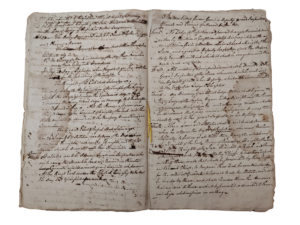
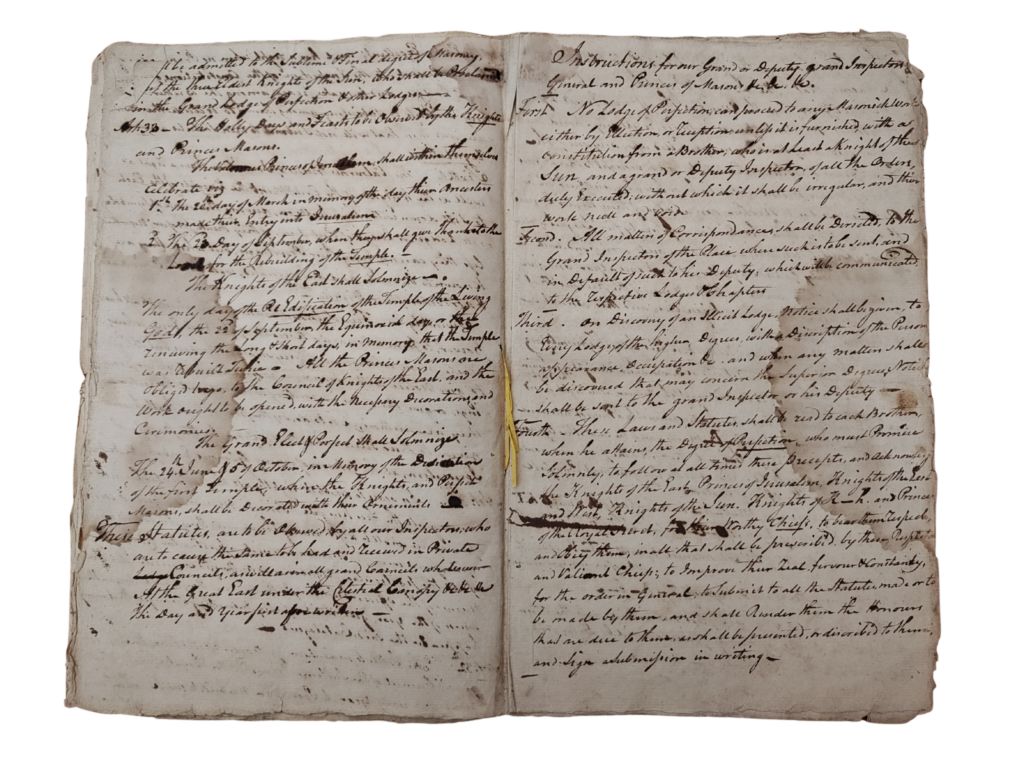
Deep in the basement of the Grand Lodge of Masons in Massachusetts, tucked among piles of yet-to-be-cataloged books and papers, sat one of the oldest Scottish Rite-related documents in America. Older than the United States and thought lost for nearly 100 years, the “Francken” Constitutions of 1762 of the Order of the Royal Secret has been brought to light once again.
The find came this past November, when library volunteer John Wilder (Grand Historian, Grand Commandery of Knights Templar of Massachusetts and Rhode Island, and Curator, Aleppo Shrine Museum and Archives) discovered the document among a pile of loose nineteenth-century papers. Noticing it appeared older than the rest, Wilder immediately brought it upstairs to the library for further study.
The document is an early manuscript copy of the Constitutions of 1762, the foundational governing document of the Order of the Royal Secret that was carried to America by Henry Andrew Francken and became the basis for the Ancient and Accepted Scottish Rite. Historian Samuel Harrison Baynard, in his 1938 The History of the Supreme Council of the 33rd Degree of Ancient Accepted Scottish Rite of Freemasonry, documented ten known copies of the 1762 Constitutions and examined the variations among them: half in French, half in English. Of the five English copies, one — which Baynard identifies as the “Francken” version — had gone missing: “Given by Henry Andrew Francken, in 1767, to the Ineffable Lodge of Perfection in Albany, New York, afterwards noted as being in the Carson Collection, but which we have been unable to locate.”1
The “Carson Collection” Baynard references belonged to Cincinnati Masonic collector Enoch Terry Carson. In 1898, shortly before Carson’s death in 1899, his entire collection was purchased by Samuel Crocker Lawrence of Massachusetts. Lawrence had previously served as Grand Master of Massachusetts and Grand Commander of the Grand Commandery of Knights Templar of Massachusetts and Rhode Island, and would go on to serve as Sovereign Grand Commander of the Supreme Council, Northern Masonic Jurisdiction (1909-1910). With this purchase, Lawrence’s collection became one of the most comprehensive private Masonic collections in the world. Upon his death in 1911, it was bequeathed to the Grand Lodge of Massachusetts.
That same Lawrence-Carson material has yielded a related discovery before: in 1935, Grand Lodge librarian Jacob Hugo Tatsch found the 1783 Francken Manuscript among these papers, shortly before it was transferred to the Supreme Council, Northern Masonic Jurisdiction. Tatsch’s early death in 1939, unfortunately, halted further identification of the Lawrence-Carson collection, and the “Francken” Constitutions lay undiscovered until now.
Though the “Francken” Constitutions originated in New York, then made their way to Ohio before coming to Massachusetts, they share an important connection with early Massachusetts Freemasonry. Among the members of Albany’s Ineffable Lodge of Perfection was Moses Michael Hays. Before departing New York in 1768, Francken made Hays a Deputy Inspector General of the Order, giving him authority to constitute lodges in North America and the West Indies. Hays eventually made his way to Rhode Island and then to Massachusetts, where he served as Grand Master from 1788 to 1792. In 1791, while Grand Master, Hays acted on his authority as Deputy Inspector General to charter King Solomon’s Lodge of Perfection in Holmes’ Hole, Martha’s Vineyard. The lodge remained active until a new charter was issued in 1797 by then Grand Master Paul Revere. Styled King Solomon in Perfection Lodge under this new charter, the lodge ceased conferring the 4th through 14th degrees and was brought in line with the craft lodges of the jurisdiction.
There is a strong possibility that Hays personally held onto the “Francken” during his lifetime, making the document’s arrival in Massachusetts in 1898 more of a return home.
While further research and study of this document remain, the Samuel Crocker Lawrence Library is grateful to John Wilder for the sharp eye that brought this document back into the light.